A Sharper Signal: Could Hearing Be CMT’s Next Clinical Trial Endpoint?
CureCMT (HNF) brought hearing testing on-site at the 2026 Clinical Trial Readiness Summit, a first for the CMT community. About half of those screened showed some hearing loss, matching what 445 GRIN registry responses had been saying for years.
A first for the CMT community
This year, CureCMT (HNF) became the first CMT organization to bring hearing testing on-site at its annual 2026 Clinical Trial Readiness Summit and to walk away with real research data because of it. Thanks to our patients, sponsors, and our partnership with Shoebox, we offered free hearing screenings to the CMT community. What we found is more than a health check; it’s the next step in a research thread CureCMT (HNF) has been pulling on for years.
Where this started
The story goes back further than this year’s Summit. CureCMT (HNF) has long tracked hearing concerns through GRIN’s Hearing, Eyes, and Ears survey, part of the broader NIH-validated ClinGen survey set that captures the patient-reported picture of CMT. Patients had been telling us about hearing loss for years through that survey; what this Summit’s clinical screening gave us for the first time was hard data to match it against.
That combination of years of patient-reported signal, now backed by real clinical screening, is what lets us ask the bigger questions: Is hearing loss a defined phenotype of CMT? Which mutations and variants shape that part of the patient journey? And can hearing become a real way to measure whether a treatment is working using hearing loss and improvement as a clinical trial endpoint? This year’s Summit session on Hidden Outcomes in CMT addressed many of these questions.
Long before this year’s Summit screening, CureCMT (HNF)’s own registry had already been telling this story. Patients enrolled in GRIN’s Hearing, Eyes, and Ears survey: 445 of them with complete responses collected over the life of the registry have reported hearing- and ear-related symptoms at levels that echo almost exactly what clinicians found on-site in April. Roughly 43% of respondents reported some degree of hearing impairment or loss, and nearly a quarter specifically reported sensorineural hearing loss, the type tied to the auditory nerve demyelination researchers believe drives CMT-related hearing changes.
Ringing in the ears turned out to be even more common, reported by close to 70% of respondents, while more than a third reported vertigo and nearly 30% reported hyperacusis. Taken together, roughly two in three respondents reported at least one type of hearing loss, years of patient-reported signal that lines up almost exactly with the ~50% rate the Summit’s clinical screening turned up this spring, giving real clinical weight to what patients had been reporting on their own all along.
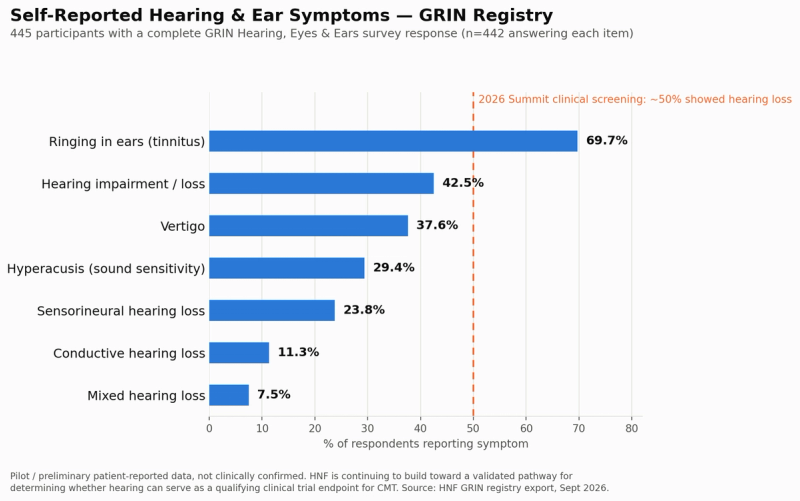
This is still pilot data. A single Summit screening of 31 patients, paired with one cut of registry survey responses, is an important first signal, not a conclusion. Larger samples, clinical validation, and continued follow-up are still needed before hearing loss can be treated as a confirmed, measurable feature of CMT’s natural history. CureCMT (HNF) will continue building toward that goal: developing a clear pathway to determine whether hearing loss can be validated as a qualifying endpoint for CMT clinical trials, and expanding both GRIN survey participation and on-site screening at future Summits to get there.
This Summit’s screening data is the opening data point in that case. We intend to build it until hearing loss gets the attention it deserves in CMT, including recognition as an outcome measure in future clinical trials.
By the numbers
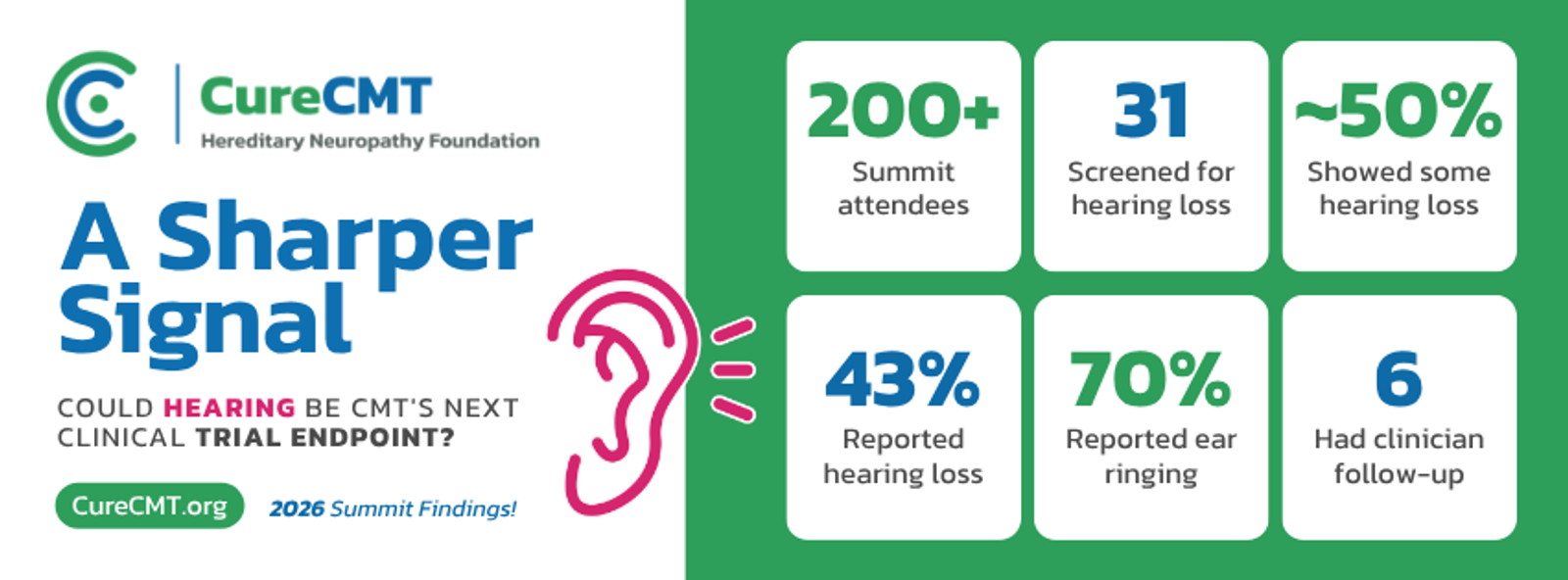
- 200+ attendees at the 2026 Summit
- 31 community members screened
- ~50% showed some degree of hearing loss
- 6 had a deeper conversation with a clinician
Over 200 people came to this year’s Summit in April. Thirty-one of them stepped up for our very first on-site hearing screening, many already suspecting something was off with their hearing. It’s a small first step. It’s also the start of something we plan to grow at every Summit from here on out.
What we found
Of the 31 screened, 27 got an automatic result on the spot; the other 4 had a fuller conversation with a clinician due to more complex hearing histories.
Among the 27 automatic results:
- 13 tested normal in both ears
- 11 had some loss in both ears
- 3 had loss in just one ear
That’s roughly half the group showing some degree of hearing loss well above what you’d expect in the general population, and precisely in line with what researchers have long suspected about the connection between CMT and hearing, and with what our own GRIN data pointed to first.
Where loss showed up, it was mild to moderate; nobody screened came back with a severe result. And the pattern was consistent: hearing held up for lower and mid-range sounds but weakened as pitch climbed (think high-pitched beeps or birdsong). That’s the signature of a gradual, degenerative process, not sudden or noise-driven damage. Gradual, measurable, progressive: exactly the kind of signal a clinical trial endpoint needs.
Backed by published research
Our numbers aren’t an outlier. They line up with the literature almost exactly:
Hearing loss has been recognized as a genuine feature of CMT since the 1970s. It appears often enough in CMT1A, the most common subtype, that a 2024 systematic review and meta-analysis treated it as a core finding across the literature, not a coincidence. Our roughly 50% rate matches that body of research almost exactly.
The mechanism traces back to demyelination of the auditory nerve, a peripheral nerve, just like the ones CMT is known to affect. That explains the gradual, high-frequency pattern we saw at the Summit, and it’s a big part of why hearing could work as a sensitive, trackable signal of disease progression over time.
Why hearing could be the sharper signal
Current CMT outcome measures, strength, sensation, walking ability, can be slow to shift and hard to standardize across patients. Hearing is different: it’s objective, quantifiable, testable in minutes, and based on what we saw changes in a predictable, progressive pattern tied directly to the nerve damage at the heart of CMT. That combination is exactly what makes an outcome measure valuable in a clinical trial.
If you have CMT, your data is part of this story
The single biggest way to help move this from a promising signal to a recognized outcome measure is simple: join GRIN and complete the Hearing, Eyes, and Ears survey, even if you don’t have hearing loss. It’s just as important to hear from patients without hearing changes as it is from those with them. We’re studying the full prevalence of hearing involvement in CMT and how it shows up across different variants and mutations, and that picture only comes together when everyone responds, not just the people who notice a problem.
Join GRIN. Free, confidential, and open to anyone diagnosed with CMT.
Why this matters for our partners
None of this happens without the partners who fund and staff it. What we found here does two things at once: it confirms that hearing changes are common enough and consistent enough with published science and our own registry data to justify screening at every future Summit, and it hands us something no spreadsheet can: real, specific stories to bring back to the people who make this work possible.
Every Summit from here forward adds to the dataset. And that dataset is how we move hearing from an overlooked symptom to a recognized outcome measure in CMT clinical trials, not someday, but on a timeline we’re actively building toward.
References
- Charcot-Marie-Tooth Disease and Hearing Loss: A Systematic Review With Meta-Analysis (PubMed, 2024)
- Audiological findings in the Charcot-Marie-Tooth Disease (PMC)