Mitochondrial CMTs
Mitochondria are the powerhouses of our cells, the body's batteries. Some forms of Charcot-Marie-Tooth disease are caused by mutations in genes that affect how mitochondria work, and because peripheral nerves are especially dependent on a steady energy supply, those problems can surface as the muscle weakness and sensory changes of CMT. This is HNF's hub for mitochondrial-related CMT.
What mitochondrial CMT means
CMT is linked to mitochondrial disorders, but not all mitochondrial disorders are linked to CMT, and CMT itself is not a mitochondrial disorder. The connection is real but specific: certain CMT mutations affect mitochondria directly, while others affect them indirectly.
Mitochondria produce energy through a process called oxidative phosphorylation. In some CMT subtypes, mitochondrial function is impaired, which lowers energy production and raises oxidative stress. That combination can contribute to peripheral neuropathy, the primary feature of CMT. Mitochondria also help regulate calcium balance and programmed cell death, both of which can be disrupted in these subtypes.
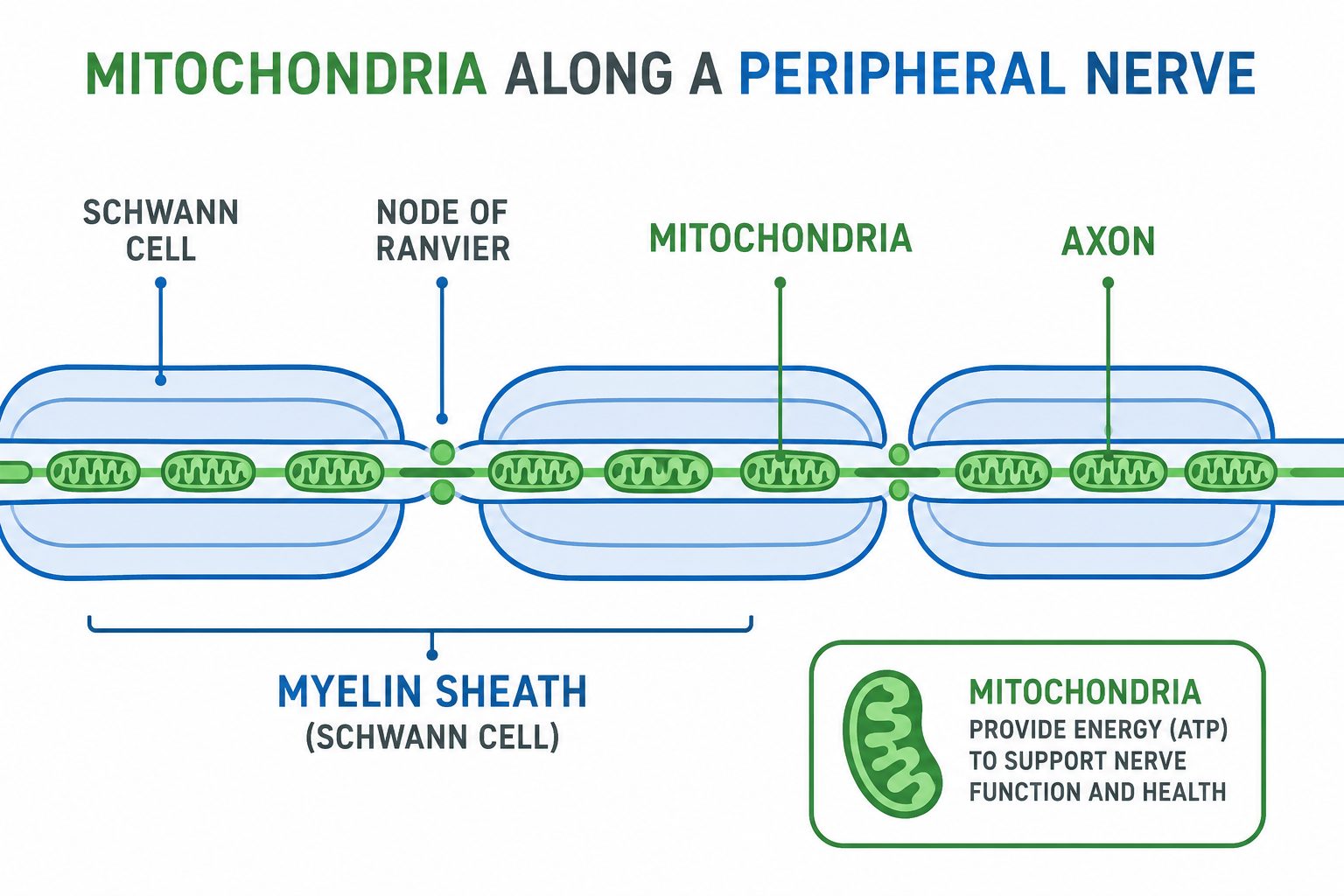
Why mitochondrial function matters in neuropathy
Mitochondria do more than make energy, and several of their jobs are exactly the ones that go wrong in these forms of CMT. Four of them stand out.
The mitochondrial CMT subtypes HNF focuses on
These subtypes group by what they affect: the shape of the mitochondrial network (GDAP1 and MFN2), and the machinery mitochondria use to make their own proteins, which is CMT6, caused by the MTRFR gene, also known as C12orf65. Optic atrophy, a thinning of the nerve to the eye that can affect vision, is seen in both CMT6 and CMT2A. Each card below links to a dedicated page with more on that subtype.
Mitochondrial network: MFN2 and GDAP1
Mitochondrial protein machinery: CMT6 (MTRFR / C12orf65)
How HNF is advancing mitochondrial CMT research
HNF's approach to mitochondrial CMT starts with the subtypes families have rallied behind. Rather than betting on a single subtype, HNF builds the research tools that any mitochondrial subtype can be studied with, then applies them across the group: MFN2 and GDAP1, which shape the mitochondrial network, and MTRFR, the gene behind CMT6.
That toolkit is the point. Patient-derived stem cells, known as iPSCs, let researchers study living nerve cells carrying a patient's own mutation. Animal models, including HNF-supported rat models, show how the disease behaves in a whole nervous system. Natural history data and biomarkers make it possible to tell whether a candidate therapy is actually changing the course of the disease. Each of those pieces is expensive and slow to build, and each one is reusable, so a tool built for one subtype shortens the path for the next.
This is what makes a treatment possible rather than merely hoped for. A drug developer working on a mitochondrial CMT subtype needs a model to test in, a way to measure benefit, and patients who can be identified and enrolled. HNF's work is to have those ready in advance, so that when a promising compound or gene therapy appears, the years of groundwork are already done.
Frequently asked questions
Are mitochondrial CMTs the same as mitochondrial disease?
No. CMT is not a mitochondrial disorder, and not all mitochondrial disorders involve CMT. The overlap is specific: several CMT subtypes are caused by genes that affect how mitochondria work, directly or indirectly.
Why do mitochondrial problems show up as neuropathy?
Mitochondria produce cellular energy. The long peripheral nerves running to the hands and feet have a high energy demand, so they are often hit first when mitochondrial function falters, which surfaces as the muscle weakness and sensory changes of CMT.
Which CMT subtypes are linked to mitochondrial function?
HNF focuses on subtypes that affect the shape of the mitochondrial network (MFN2, linked to CMT2A, and GDAP1, linked to CMT4A/2K) and those that affect the machinery mitochondria use to make their own proteins (MTRFR, also known as C12orf65), the gene behind CMT6. Optic atrophy, a thinning of the nerve to the eye that can affect vision, is seen in both CMT6 and CMT2A.
How can patients help mitochondrial CMT research?
Much about how mitochondrial changes affect CMT is still poorly understood. Joining GRIN and completing the ClinGen surveys captures the head-to-toe data researchers need to study mitochondrial involvement.
Help advance mitochondrial CMT research
If you are living with a mitochondrial CMT, or caring for someone who is, the most powerful thing you can do is add your data to the research. Join GRIN, complete the ClinGen surveys, and explore whether genetic testing is right for you.
Want the full picture of HNF's research engine? Start with the TRIAD Model →