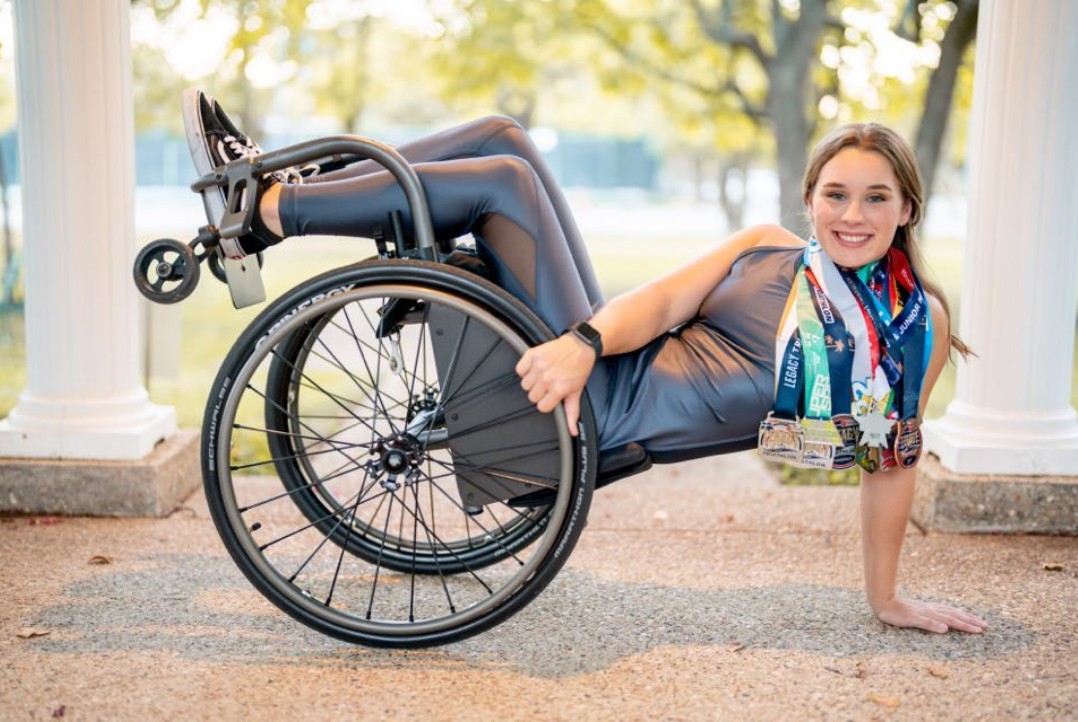
A name for something she had felt for years
Skyler was diagnosed with CMT at thirteen. Before that she knew something was different about her legs and feet without understanding why. Running, balance, coordination and endurance had always been harder for her than for other kids, and she had weakness in her feet. Eventually her doctors started looking into it properly, and a referral for genetic testing and a neurology evaluation gave the answer: Charcot-Marie-Tooth disease.
She does not think she understood at the time what the diagnosis meant or how much it would shape her life. Mostly she just knew she finally had a name for something she had been struggling with for years.
Her subtype is CMT2A. It affects the nerves that control the muscles furthest from the body, so for her it lands in the legs and feet as weakness, fatigue, coordination and balance problems, and muscle tightness.
Training, school, recovery, and managing energy
Her days look different from most people her age. She is a full-time college student studying pre-veterinary science and an elite para triathlete training at the U.S. Olympic and Paralympic Training Center, so most of her time goes on training, school, recovery, and managing her energy.
The genuinely hard parts are walking long distances, standing for long periods, stairs, uneven ground, and doing any of it when her legs are already tired. Balance and coordination get harder as fatigue builds.
Something that people don’t always realize is that CMT fatigue isn’t just being tired after a long day. My muscles and nerves can reach a point where they just don’t cooperate the way I want them to.
Skyler Fisher
What she has got good at is doing things differently: pacing herself, planning her energy, modifying exercises, using adaptive equipment, and asking for help when she needs it.
I’ve also learned that doing something differently doesn’t mean I’m doing it wrong.
Skyler Fisher
The equipment, and adapting the sport
Supportive shoes, orthotics and bracing when she needs them, mobility equipment, and modifications to how she trains. She uses a wheelchair for longer distances and for situations where walking would cost too much energy.
In triathlon she has found ways to adapt her equipment and technique to work with her body rather than fight it. She does not kick when she swims, and her bike and run setups carry adaptations that let her compete at an elite level. Planning recovery is part of it too, and recognizing when her body needs a break.
I’ve had to learn that rest is part of training, not something I have to earn.
Skyler Fisher
Why she became a Dream Team ambassador
She knows how isolating a rare disease can feel, especially when you are young and do not know anyone else who has it. When she was diagnosed she had no picture of what her life could look like. She wants other people with CMT, above all kids and parents, to see that a diagnosis does not automatically mean giving up the things you love.
My life looks different than I imagined when I was younger, but it is still a really full life.
Skyler Fisher
She also wants people to understand that CMT looks different for everyone, that disability does not have one appearance, and that someone can face significant challenges while doing things others would never expect.
What she would say to a parent who just got the news
I would tell them not to panic and not to assume they know what their child’s future is going to look like. A diagnosis can feel really scary because you immediately start thinking about everything your child might not be able to do. But you don’t know yet what they WILL be able to do.
Skyler Fisher
Let your child work out who they are instead of letting the diagnosis define them. Give them the tools and the support, but also let them take risks, try things, fail, and find what they love. And let them be a kid.
CMT is part of my life, but it is not my entire identity. I’m an athlete, a student, an animal lover, a friend, and a million other things too.
Skyler Fisher
What she is proud of
Becoming an elite para triathlete. She has competed nationally and internationally, won multiple USA Para Triathlon National Championships, raced at the World Triathlon Para Championships and finished sixth at Worlds. She is working toward competing at Paralympic level while pursuing a career with animals.
She is proudest, though, of something quieter: learning to advocate for herself, to explain what she needs, to speak up when something is not accessible, and to understand that asking for accommodations does not make her less capable.
The thing nobody asks her about
People ask what she can physically do. They rarely ask what it feels like mentally to have your body constantly change, or to have to think about things most people never think about. There are days she is frustrated, exhausted or angry about working so much harder to do something that looks easy for everyone else. Because she is an athlete who accomplishes a lot, people assume CMT must not really affect her. It does. She has learned to keep going while carrying it.
Being disabled and being capable are not opposites. I can need help with something and still be incredibly independent. I can use a wheelchair and still be an elite athlete. I can struggle with walking and still race a triathlon.
Skyler Fisher