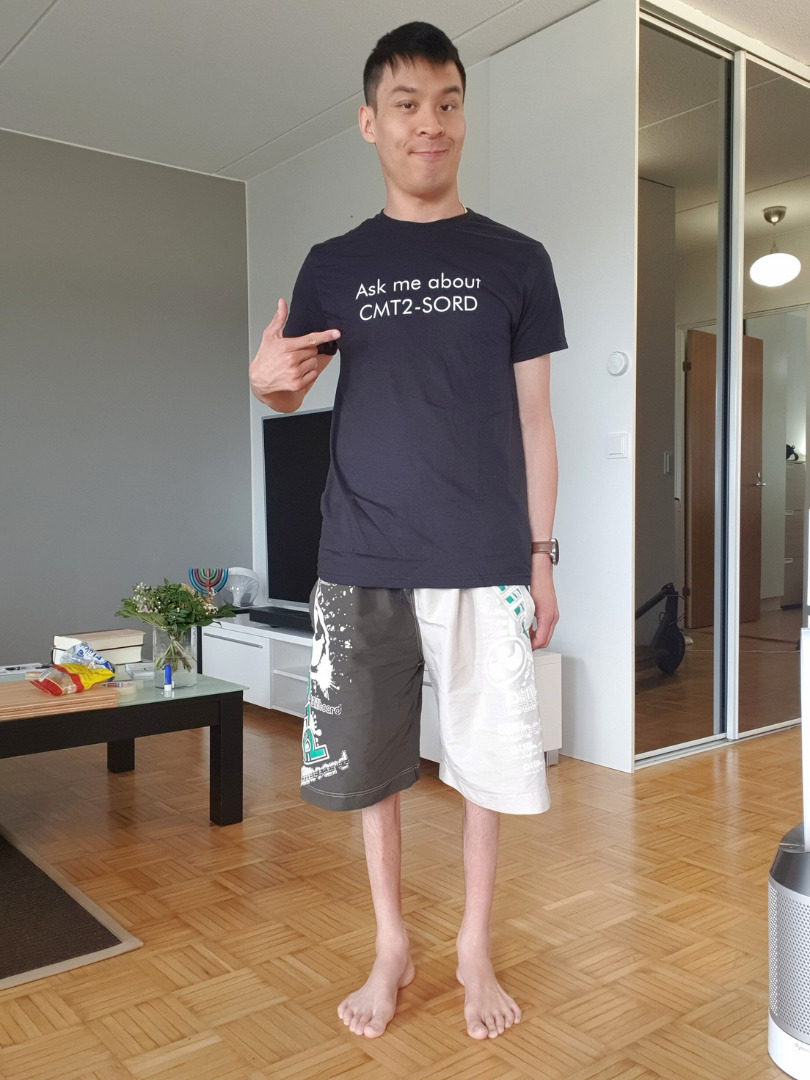
Not even couch potatoes get legs like that
Chris was diagnosed in 2021, about eighteen months after his wife, his girlfriend at the time and a physician, looked at his legs. He had assumed he had somehow done it to himself.
Not even couch potatoes get legs like that.
Chris's wife, on first seeing his legs
She referred him. He is clear about what that was worth.
Without her, it would've probably still taken a decade or two.
Christopher Gullmans
His subtype is CMT-SORD, one of the rarer forms and one only identified in recent years.
A disabled parent to a disabled child
Chris is a father to a son with Down syndrome, and he says the days can be very tough. There is extra physical strain, and there are practical problems that come with being a disabled parent to a disabled child.
The one that dominates everything else is rest. When he does not get enough of it, it shows up straight away in walking, standing, using his arms and hands, and in his capacity to think. Fatigue is a constant concern rather than an occasional one.
As I've slowly come to terms with my limitations, I've begun accepting tools and adaptive devices that help me on a daily basis.
Christopher Gullmans
What he wears, what he uses, and what he invented
Ankle-foot orthoses, zippered shoes, buttonless clothing, and clothing chosen for his son that makes dressing him easier too. In the kitchen, tools with good grips, and food that takes less cutting and prep, like frozen vegetables and pre-cut meat.
The adaptation he likes to brag about is his own. He cannot run around after his son, so he bought a remote-control car for his son to chase instead.
It's fun for both of us (and an excuse to buy gizmos I don't have to justify to my wife, lol)!
Christopher Gullmans
Decades of advocacy before CMT
Becoming a Dream Team ambassador was a continuation of advocacy he had already been doing for years, for himself and for his son. Chris was an orphan, and for a long time he was a mentor and ambassador for an adoption association, helping parents and children through adoption. He carried that work on when he learned about his own disability, and again shortly afterwards when his son was diagnosed with Down syndrome.
Knowing there are others out there in the same situation I've been in, is empowering, because nobody knows how to deal with these things better than the people who live with it.
Christopher Gullmans
I live by the philosophy that my challenges have been worth it if I can use it for good.
Christopher Gullmans
What he wants a newly diagnosed person to hear
First, that they are not alone. CMT shows up differently in different people, but he thinks this is an unusually good moment to be diagnosed into: social media to find others in the same situation, foundations like HNF for resources and research, adaptive devices, and accessibility law.
While the challenges will always stay the same, the abilities and possibilities to live a happy and satisfying life have come a long, long way in just a few decades, and will continue to progress. So don't live by outdated notions that we can't make a difference, because we can and will!
Christopher Gullmans
The path less travelled
Asked what he is proud of since his diagnosis, he says becoming a parent. He calls it one of the hardest things in life and also the most satisfying, and he chose it despite his own disability and while expecting a child with a disability.
It also meant taking the path lesser travelled, and I'm incredibly proud of our unique path that brings so many opportunities to meet people we would never otherwise meet, and discover beautiful places and the proverbial scenic routes nobody would ever take unless they are forced to.
Christopher Gullmans
Their plans were completely upended. He counts that as the point rather than the cost. It took them to another country and helped them work out where they actually belong, instead of leaving them stuck in the life they had assumed was meant for them.
The thing nobody asks him about
Do I wish I didn't have CMT? Absolutely. But would I trade it for a life where I had never met all the amazing people through my advocacy? Never in a thousand lifetimes. I have something most others will never have: A drive to make the world a better place without asking for anything in return.
Christopher Gullmans