
Rishi Sharma CMT 2A Wheelchair Rugby
Rishi's CMT story
I am Rishi and I have CMT2A. I was first diagnosed at two years-old. When my parents asked what could be done, they got the famous and horrific answer so many of us have gotten, “nothing can be done and there is no treatment. The disease is progressive and will only get worse to the point where he may end up in a wheelchair” (mic drop moment). I look back on that and kind of laugh at that being considered the “worst” prognosis. There are far worse outcomes in my opinion. The doctors were right about the progression aspect as I started to experience foot drop, hand and wrist weakness, and fatigue as I got older. By age 13, I was fully using a wheelchair to get around. This transition was a hard one as people did not understand (including myself for a long time) why I went from walking to being in a wheelchair. I got questions like “What happened?” or “Can you still walk?” from strangers, friends, and even family members. These questions were hard to answer and they left me with emotions like anger, sadness, worry, and depression. I was in denial of my disease for a long time.
It wasn’t until 16 years of age that I started embracing my disease and the wheelchair; however,I needed a new one. Just like AFOs, a well-fitted wheelchair that has everything you need can be life changing for the user. I got a TiLite ZR made exactly to my specifications and it has made my life far easier and made me more independent. I had to look at the positives of being in a wheelchair, like never having to worry about losing my balance, getting a great arm workout everyday pushing myself, and not having to wear AFOs (which I hated) everyday just to be able to get around. The wheelchair also opened up COMMUNITY Number 34: Rishi 8 hnf-cure.org the possibility of me being an athlete, which I never thought would be an option for me. Trying wheelchair sports changed my life for the better.
I started off playing wheelchair basketball and I realized it wasn't for me. Then I found wheelchair rugby. What attracted me to the sport was that all athletes must have deficiencies in three or four of their limbs to be able to participate. This put me at an equal playing field for once in my life.
It’s a hardcore activity and I’ve met many great people with similar or the exact same disability as me who also play this sport. What intrigued me the most about this sport was just how many Paralympic athletes there were who played wheelchair rugby for their country’s team and have CMT. Almost every wheelchair rugby team that qualifies for the Olympics has at least one player on the team that has CMT or an inherited neuropathy. I hope and train for the day to be on the U.S. wheelchair rugby team. With this sport comes a lot of training. I use specialized lifting hooks (which have been game changers for me) that I use at the gym to lift weights and do cable exercises. I truly believe the only way to currently slow down/stop the progression of this disease (in my opinion) is exercising and eating right.
I have shared my passion for wheelchair rugby and weightlifting with you, but there is one more passion that tops both of these. That passion is to find a treatment/cure for CMT. I dove deep into the world of neurodegenerative diseases and have found a common trend amongst most of them, there is no treatment. This is starting to change however with the discovery of highly specialized gene therapy. The big issue with CMT is there are so many different genes that can cause this disease and each subtype needs a different form of gene therapy to correct whatever the error is in the genome. At the bare MINIMUM I want to see a treatment that halts the progression of CMT2A and other subtypes.
I am glad to see non-profits like the Hereditary Neuropathy Foundation (HNF) team up with the FDA, researchers, biotech companies, and investors to push effective, life-changing treatments into the clinic. I am extremely optimistic for the future and want to continue to work with the HNF on achieving the goal of finding a treatment/cure for all forms of CMT.
Rishi also put together a rundown of how the sport actually works.
Rishi's rules of Wheelchair Rugby
Here are some of the key rules and regulations of wheelchair rugby (there are many more, but these are the important ones):
1. Everyone is given a classification based on their physical function: 0.5, 1.0, 1.5, 2.0, 2.5, 3.0, or 3.5. This value is set by highly skilled physical therapists, known as classifiers, who run manual muscle tests and watch an athlete play to determine an appropriate point value. The higher the value (3.5 is the highest, 0.5 the lowest) the more function that player has. I am a 2.0, and I have seen other players with CMT as high as 3.5 or as low as 1.0, because CMT affects everyone differently. Players who are 45 or older, or who are female, get an automatic 0.5 deduction.
2. Only 4 players from each team are on the court at a time, and the combined point value of those players cannot exceed 8. For example, if a team puts four 3.0 players on the court, that is 12 points, which exceeds the 8 allowed, an illegal lineup that results in forfeiting the game. This rule makes sure all players get a chance to play.
3. There are two types of chairs. The offensive chair is mainly used by higher functioning players and is built to be nimble, more circular, made to weave in between and around players. The defensive chair has an elongated front end that resembles a pick axe; it is mainly used by lower functioning players and is designed to "pick" the front of an opponent’s wheel or chair. Done correctly, it can stop an opponent in their tracks (the sport is co-ed). If you are having a hard time picturing it, here are the two chairs:
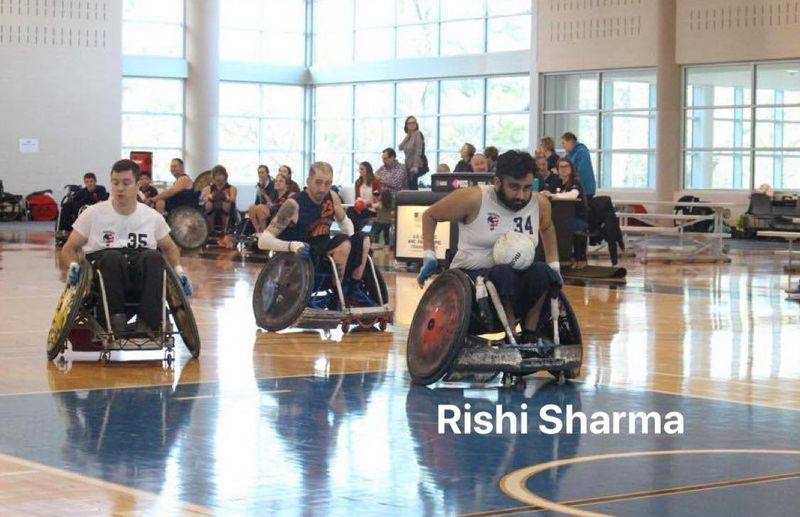
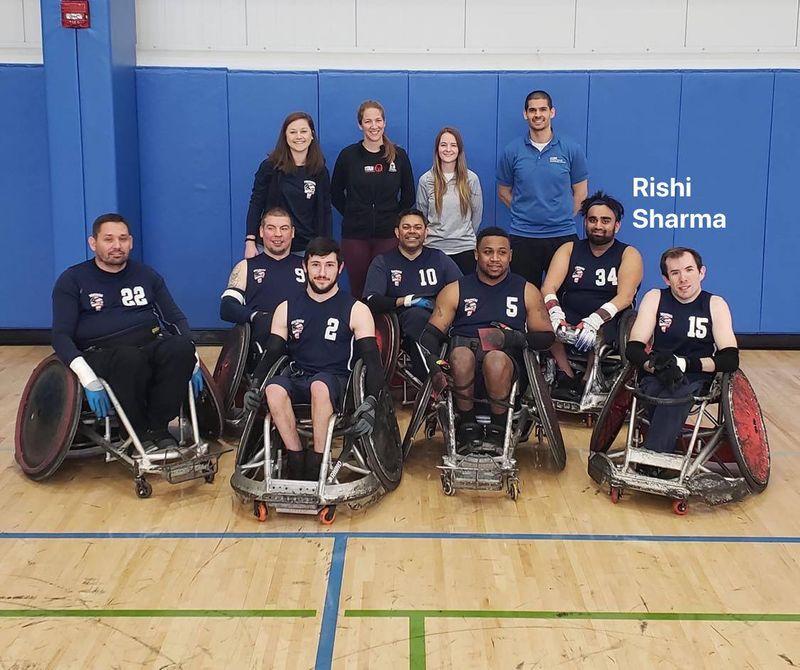
4. The game blends hockey, soccer, able-bodied rugby, American football, and wheelchair basketball, played on a full size indoor basketball court. At each baseline, two cones 12 feet apart make up the goal. A goal, or "try," is scored every time a player carrying the ball crosses between the two cones. The ball is a large volleyball and can be thrown in any direction (not just backward like able-bodied rugby). No player-on-player contact is allowed, but full chair contact is allowed and encouraged. In other words, you can’t hit a person, but you can hit their chair as hard as you want, even if they flip over.
5. The game is played in four 8-minute quarters and begins with a tip-off at center court. When a goal is scored, possession changes. On offense you have 10 seconds to inbound the ball, 12 seconds to get it past half court, and 40 seconds to score; if you don’t score in 40 seconds, possession changes.
It may seem like a lot to take in, but it should give you a good idea of what the sport looks like. Have fun!