Surgery
Many people with CMT need surgery at some point to correct deformities in the feet, spine, or hips. When it is done early, surgery can protect strength, ease pain, and prevent problems from becoming fixed and harder to treat.

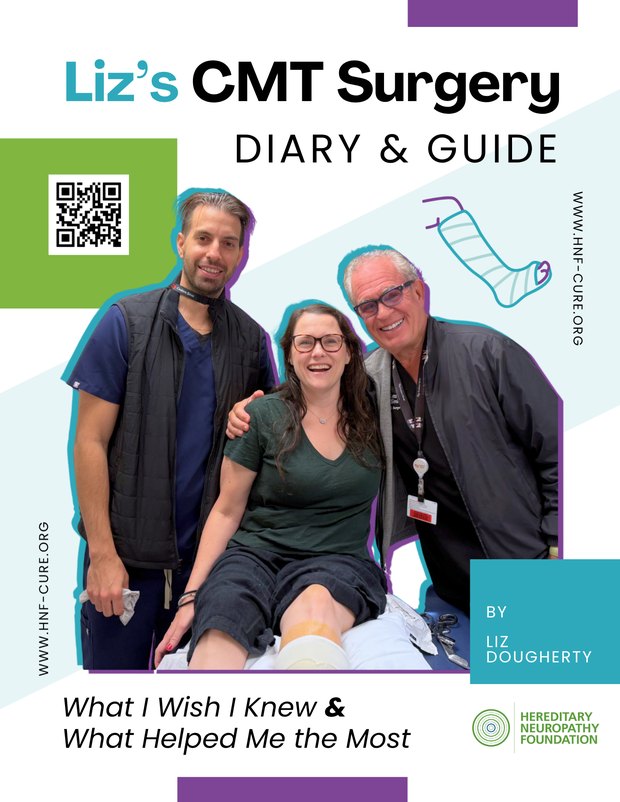
Free HNF guide
Get the CMT Surgery guide
By Liz Dougherty
Liz's personal diary is your go-to guide for what to expect, from travel tips and pain management to packing lists and emotional support. Read the real, unfiltered experience that will help you feel more prepared and less alone.
At a glance
- Surgery done early can preserve strength and prevent deformities from becoming fixed and harder to treat.
- Most CMT surgeries involve the foot, correcting problems like high arch (cavus), inward heel (varus), and claw toes.
- Scoliosis and hip dysplasia can develop quietly, so regular X-rays during childhood growth are important.
- Tell your anesthesiologist you have CMT, and ask about muscle relaxants: whether one is required, whether it could have a prolonged effect on your affected muscles, and which would be safest.
- HNF offers a free virtual surgery evaluation with Dr. Glenn Pfeffer at Cedars-Sinai using three short at-home videos.
How surgery can help
Most people with moderate to severe CMT can be helped with surgery. Done early enough, procedures like tendon transfers and osteotomies can increase strength and endurance by removing the forces that pull a joint out of position.
If a deformity becomes fixed, more involved procedures such as a triple arthrodesis (a fusion of joints in the foot) may be needed. Over time, some people with CMT need surgery to correct problems in the foot, the spine (scoliosis), or the hip (hip dysplasia).
If you are getting ready for foot surgery, a surgical diary can help you prepare. It walks you through travel tips, pain management, what to pack, and the emotional side of recovery.
Pain
Foot pain is often a sign that surgery may be needed. In some cases, though, simply shaving down a callus brings relief.
There is a helpful webinar with CMT surgeon Dr. Wayne Berberian that covers both non-surgical and surgical ways to treat pain.
Spine
About 38% of children with CMT develop scoliosis. Unlike the more common adolescent scoliosis, CMT-related curves tend to increase kyphosis, a rounding of the back.
Scoliosis linked to CMT does not seem to respond well to bracing, and a spinal fusion is sometimes needed if the curve keeps getting worse. A pediatric orthopedic surgeon will monitor the spine with regular X-rays as your child grows.
There is no good evidence that special exercises, chiropractic manipulation, or other non-surgical treatments change how a curve progresses.
Foot
Most CMT surgeries involve the foot. Weakness in the peroneal muscles, the tibialis anterior, and the small intrinsic muscles of the foot leads to contractures. These include equinus (the foot pointing down), cavus (a high arch), and varus (the heel tilting inward).
Claw toes come from weakness in the small foot muscles combined with an attempt to use the long toe extensors to lift the ankle. Cavus and varus often occur together and cannot be corrected with a brace.
Common foot deformities and how they are treated
Equinus deformity means the foot points down. Walking slightly on tiptoes is not always a problem, but a severe contracture affects balance. Lengthening the heel cord lets the foot reach a neutral position. Surgeons are careful not to over-lengthen, which causes a calcaneus (heel-walking) deformity that is considered worse than equinus.
Cavus deformity is a high arch. It comes from weak dorsiflexion and toe clawing as the extensors try to make up for a weak tibialis anterior. Treatment can range from tendon transfers and a plantar fascia release to bone osteotomies, often used in combination.
Varus of the hindfoot usually goes along with cavus. The heel tilts inward so you walk on the outer edge of the foot, which leads to painful calluses and ankle sprains. Treatment includes calcaneal osteotomies that shift the heel outward, and sometimes tendon transfers.
Early surgery is often recommended for these deformities. It helps prevent them from becoming very rigid and fixed, which can leave joint fusion, such as a triple arthrodesis, as the only option.
Hip
Hip dysplasia occurs in up to 8% of people with CMT. It can develop quietly, without early pain or any loss of motion, and eventually cause early arthritis.
Because of this, pediatric orthopedic surgeons take regular pelvic X-rays during childhood growth to watch for it. When surgery is needed, it may involve the socket side (the acetabulum), the thigh-bone side (the femur), or both.
Anesthesia and CMT
If you have a neuromuscular condition, certain precautions matter during surgery. It is best to talk with the anesthesiologist the day before your planned procedure.
One particular issue to discuss with your anesthesiologist is the use of muscle relaxant for your case. The following questions can help guide a more thorough discussion: Is it required? Would the drug have a prolonged effect on my affected muscles? Which one would be the safest choice? Make sure your surgical team knows you have CMT.
Advice for parents
Stay informed about CMT and about your child's specific condition. Keep up with regular follow-ups with a pediatric orthopedic surgeon who understands CMT, and never hesitate to ask questions.
Be cautious of websites that claim to cure CMT through manipulation, diet, or special therapies. If you want to try an alternative treatment, review it with your surgeon first.
Understanding your child's condition and the options available is the best way to help them live a happy, healthy life.
Free virtual surgery evaluation with a CMT expert
HNF partners with Dr. Glenn Pfeffer at Cedars-Sinai to offer a complimentary virtual surgery evaluation. To be evaluated, you record three short videos and send them in by email to request a virtual appointment.
First, a video of you walking barefoot, back and forth toward and away from the camera and then across it, with the camera kept low near the floor. Second, a seated video with your feet dangling, moving your ankles up and down and then side to side with as much force as you can, one side at a time. Third, a video of your toe movement, lifting your toes up and curling them down forcefully, each side on its own, with as little leg movement as possible.
Request your free virtual surgery evaluation
Once you have recorded the three short videos above (barefoot walking, seated ankle movement, and toe movement), request a virtual appointment with Dr. Pfeffer to discuss them. Fill this in and we will email you the recording checklist again along with the address to send your videos to.
Frequently asked questions
Why is it better to have CMT surgery early?
When surgery is done early enough, procedures like tendon transfers and osteotomies can preserve strength and endurance by removing the forces that pull a joint out of position. Early treatment also helps prevent deformities from becoming rigid and fixed, which can leave a joint fusion such as a triple arthrodesis as the only option. Cavus and varus of the foot often occur together and cannot be corrected with a brace, so surgery is sometimes the right choice.
What parts of the body does CMT surgery usually involve?
Most CMT surgeries involve the foot, correcting problems like high arch (cavus), an inward-tilting heel (varus), and claw toes. Over time, some people with CMT also need surgery to correct scoliosis in the spine or hip dysplasia. Foot pain is often the first sign that surgery may be needed, though in some cases simply shaving down a callus brings relief.
Does CMT cause scoliosis in children?
About 38% of children with CMT develop scoliosis, and unlike more common adolescent curves, CMT-related scoliosis tends to increase kyphosis, a rounding of the back. It does not seem to respond well to bracing, and a spinal fusion is sometimes needed if the curve keeps getting worse. A pediatric orthopedic surgeon should monitor the spine with regular X-rays as your child grows.
What should I tell the anesthesiologist before CMT surgery?
Make sure your entire surgical team knows you have CMT, and try to talk with the anesthesiologist the day before your procedure. One particular issue to discuss is the use of muscle relaxant for your case. The following questions can help guide a more thorough discussion: Is it required? Would the drug have a prolonged effect on my affected muscles? Which one would be the safest choice?
Can I get a CMT surgery evaluation without traveling?
Yes. HNF partners with Dr. Glenn Pfeffer at Cedars-Sinai to offer a complimentary virtual surgery evaluation. You record three short at-home videos, one of you walking barefoot, one of your ankles moving up and down and side to side, and one of your toes lifting and curling, then email them in to request a virtual appointment.
Start with your subtype
The most useful first step in living well with CMT is confirming your subtype. From there, the right care and research opportunities fall into place.